The First Folio — The Book That Saved Shakespeare
Eighteen of Shakespeare's plays exist today for one reason only. In 1623, seven years after his death, two of his former colleagues decided to collect and publish his work. Without that decision, half the most famous plays in the English language would be gone.
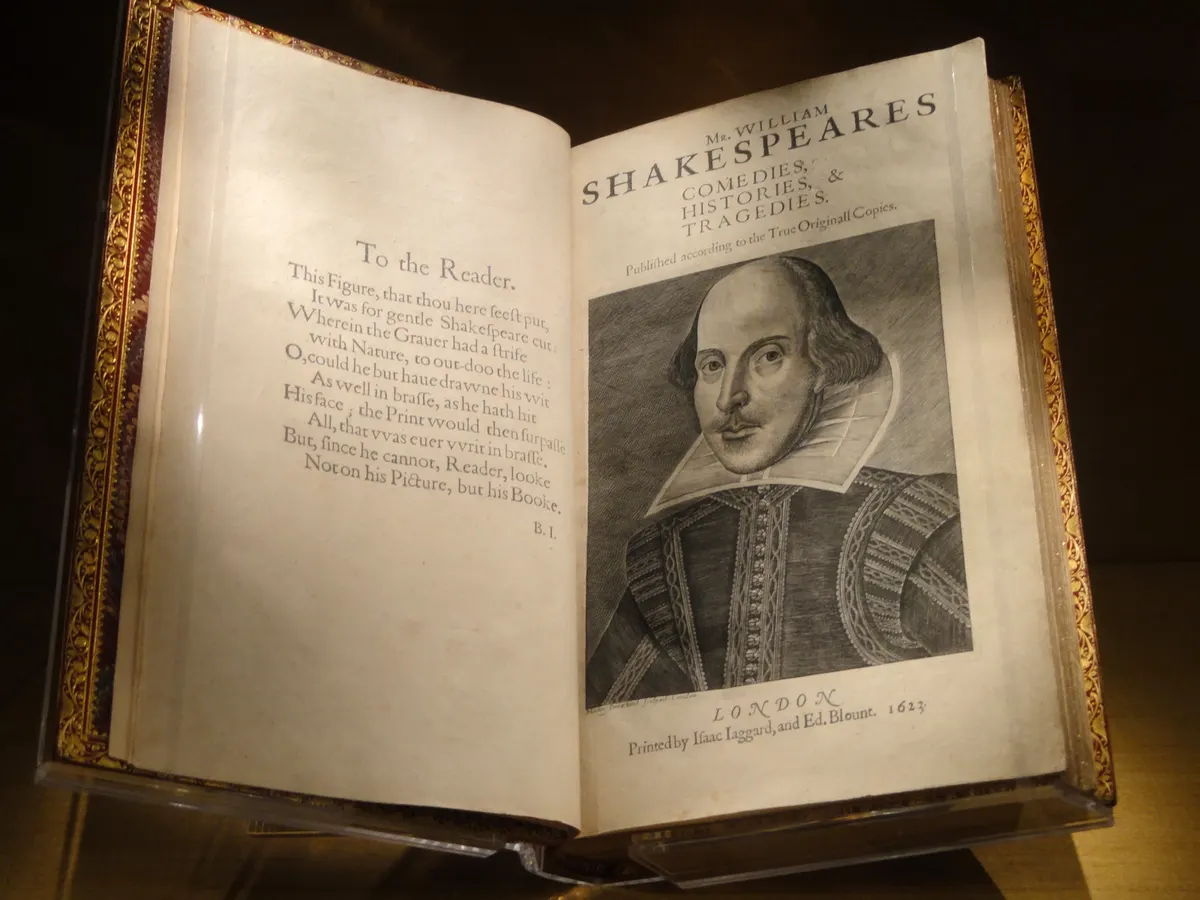
What the First Folio Is
A folio is a book printed on large sheets of paper folded once, creating four pages per sheet. The title page of the 1623 edition reads "Mr. William Shakespeares Comedies, Histories, & Tragedies" — the first time anyone had collected the plays in a single volume. It contains 36 plays and is now the most studied book in English literature after the Bible.
The term "First Folio" was coined by bibliographers to distinguish it from later collected editions: the Second Folio (1632), the Third (1663–64) and the Fourth (1685). The First is the one that matters — it is the closest surviving source to Shakespeare's own manuscripts for most of the plays it contains.
The Men Who Made It
John Heminges and Henry Condell had worked alongside Shakespeare for decades as fellow shareholders in the King's Men theatre company. They were not scholars or publishers — they were actors who had appeared in the plays themselves. Their dedication to the reader is a remarkable piece of prose: they write that they collected the plays "without ambition either of self-profit, or fame: onely to keepe the memory of so worthy a Friend & Fellow alive, as was our Shakespeare."
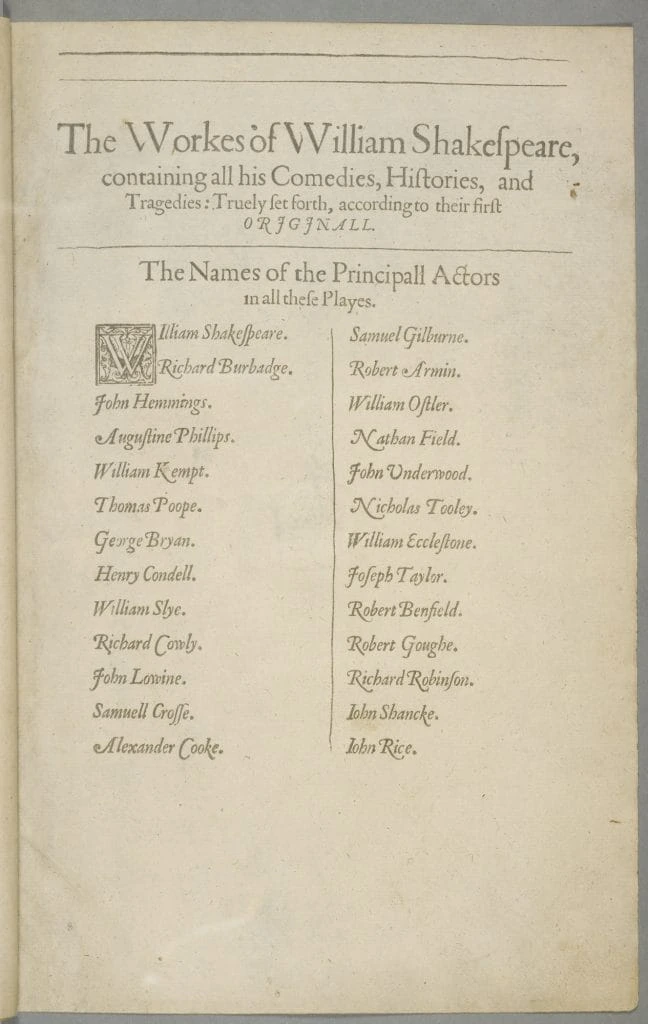
The actual printing was done by Isaac Jaggard and Edward Blount. William Jaggard, Isaac's father, had an awkward history with Shakespeare — he had published a collection called The Passionate Pilgrim in 1599, attributing poems to Shakespeare that were not all his. But business arrangements in Jacobean London were pragmatic, and the Folio went ahead regardless.
The Eighteen Plays That Would Not Exist
Of the 36 plays in the First Folio, 18 had never been printed before. Without the Folio, these plays would have survived only as prompt books and acting scripts in private hands — and almost certainly would have been lost.
The list includes Macbeth, The Tempest, Julius Caesar, As You Like It, Twelfth Night, Measure for Measure, The Comedy of Errors, Coriolanus and Cymbeline. This is not a list of minor works. These are some of Shakespeare's best-known plays.
How Many Copies Survive
Roughly 235 copies of the First Folio are known to exist today, scattered across libraries and private collections worldwide. The Folger Shakespeare Library in Washington D.C. holds 82 of them — the largest collection anywhere — because its founder, Henry Clay Folger, spent decades buying every copy he could find in the early twentieth century.
Individual copies come to auction occasionally. One sold at Christie's in New York in October 2020 for just under $10 million. The condition and completeness of surviving copies varies enormously — some have missing pages, some have been rebound, and almost no two copies are identical, because the printing process allowed for corrections mid-run.
Where You Can See One
The Folger Shakespeare Library in Washington D.C. is the obvious destination in the United States — it has 82 copies and a permanent gallery dedicated to the history of the book. In the UK, the British Library in London has five copies and displays one in its Treasures Gallery alongside the Magna Carta and the Gutenberg Bible. The Bodleian Library in Oxford holds three copies.
Shakespeare's Birthplace Trust in Stratford-upon-Avon has a copy, which can be seen on request. Many institutions that hold copies now offer digital facsimiles online — the Folger and the British Library both have high-resolution scans freely accessible.
The Imperfection Problem
Heminges and Condell were working from a patchwork of sources: fair copies, prompt books, private manuscripts. The quality of the texts varies. Macbeth appears to have been significantly cut from an earlier version — the play we have is the shortest of the tragedies, and some scenes feel compressed. The Merry Wives of Windsor is thought to be a reconstruction from memory.
Scholars have spent four centuries arguing about which readings are closest to what Shakespeare actually wrote. The First Folio is the foundation of everything we know — but it is an imperfect one, assembled by grieving colleagues working without modern editorial standards. Its value is not that it is perfect. It is that it exists at all.
Test Your Knowledge
Think you know your Shakespeare? Put it to the test with one of our free quizzes.
See all quizzes →