William Shakespeare: Biography, Life & Facts
William Shakespeare is the most famous writer in the English language, yet a surprising amount of his life is genuinely unknown. We have official records, a baptism, a marriage, a will, and we have 37 plays and 154 sonnets. What we do not have is a diary, a bundle of letters, or anyone who wrote down what he was actually like. This page sets out the life as the records show it, separating what we know from what we have simply come to believe.
Born in Stratford-upon-Avon, 1564
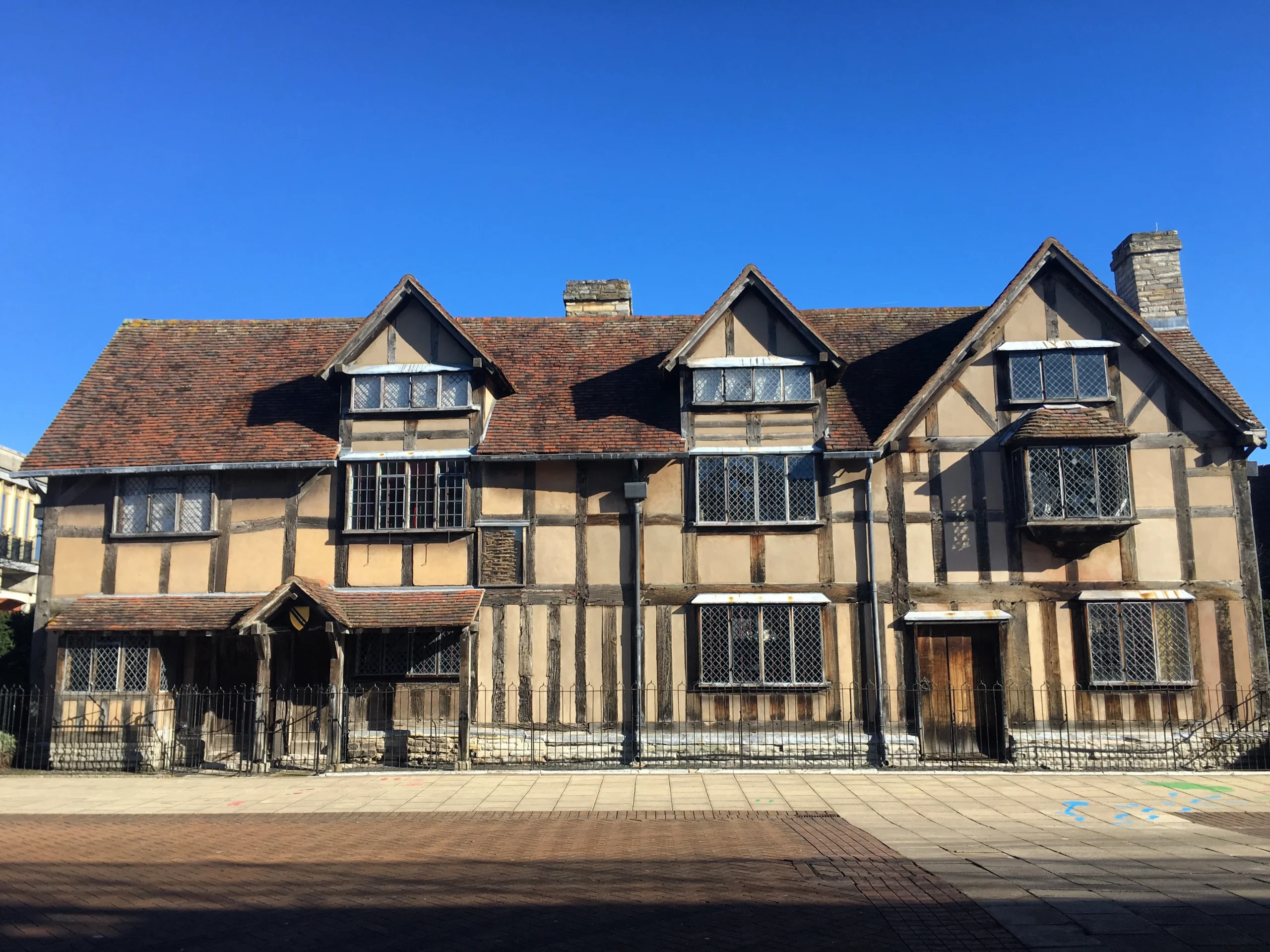
The one hard fact about Shakespeare’s birth is that he was baptised at Holy Trinity Church in Stratford-upon-Avon on 26 April 1564. His actual birthday is not recorded. The popular date of 23 April comes from an eighteenth-century scholar’s guess, and it stuck partly because it is also the day Shakespeare died, 52 years later. Biographers found the neat coincidence hard to resist.
He was the third of eight children, and the first son to survive infancy. His two older sisters had both died very young.
His father, John Shakespeare, was a glover, a maker of fine leather gloves, and a successful local businessman. John climbed the ranks of Stratford’s town government, becoming an alderman and then bailiff, the rough equivalent of mayor, around the time William was five. His mother, Mary Arden, came from a prosperous local farming family. The household William grew up in was comfortable and well-connected, at least in his early childhood.
More on the dates, the birthplace, and his family: When and Where Was Shakespeare Born?
School, marriage, and the Hathaway question
No school records survive, but Shakespeare almost certainly attended the King’s New School in Stratford, a free grammar school a short walk from his home. His father’s position in the town would have entitled him to a place. The education there was heavy on Latin. Pupils read Ovid, Cicero, and Roman drama, and that grounding shows up everywhere in the plays he later wrote.
In 1582, aged 18, he married Anne Hathaway. She was 26 and already pregnant. Their daughter Susanna was christened six months later, in 1583. Two years after that came twins, Hamnet and Judith, born in 1585.
The age gap and the timing have fed centuries of speculation about whether the marriage was happy or hurried. The honest answer is that we do not know. The one personal detail people love to cite is that Shakespeare left Anne his “second-best bed” in his will. That bequest is real, but historians disagree sharply about whether it was a slight or an affectionate nod to the bed they had actually shared.
The lost years: 1585 to 1592
After the birth of the twins in 1585, Shakespeare disappears from the record for about seven years. Nobody knows how he spent them, when exactly he left Stratford for London, or how he broke into the theatre. This gap is what scholars call the “lost years,” and it is the single biggest hole in his life story.
The vacuum has been filled with guesses for centuries. One old tradition says he fled Stratford after being caught poaching deer. Another suggests he worked for a time as a country schoolmaster. There is no solid evidence for any of it.
What we can say is that by 1592 he was in London and already making enough of a name to attract jealousy. A rival writer, Robert Greene, sneered at him in print as an “upstart crow,” a jumped-up actor presuming to write plays. It is the first surviving mention of Shakespeare’s career in the theatre, and it tells us he had already arrived.
London, the Lord Chamberlain’s Men, and the Globe
In 1594, Shakespeare became a founding member of a new acting company, the Lord Chamberlain’s Men. This was the turning point. He was not just their writer but an actor and a part-owner, a “sharer,” which meant he took a cut of the profits rather than a flat fee. It made him steadily wealthy in a way that writing alone never could.
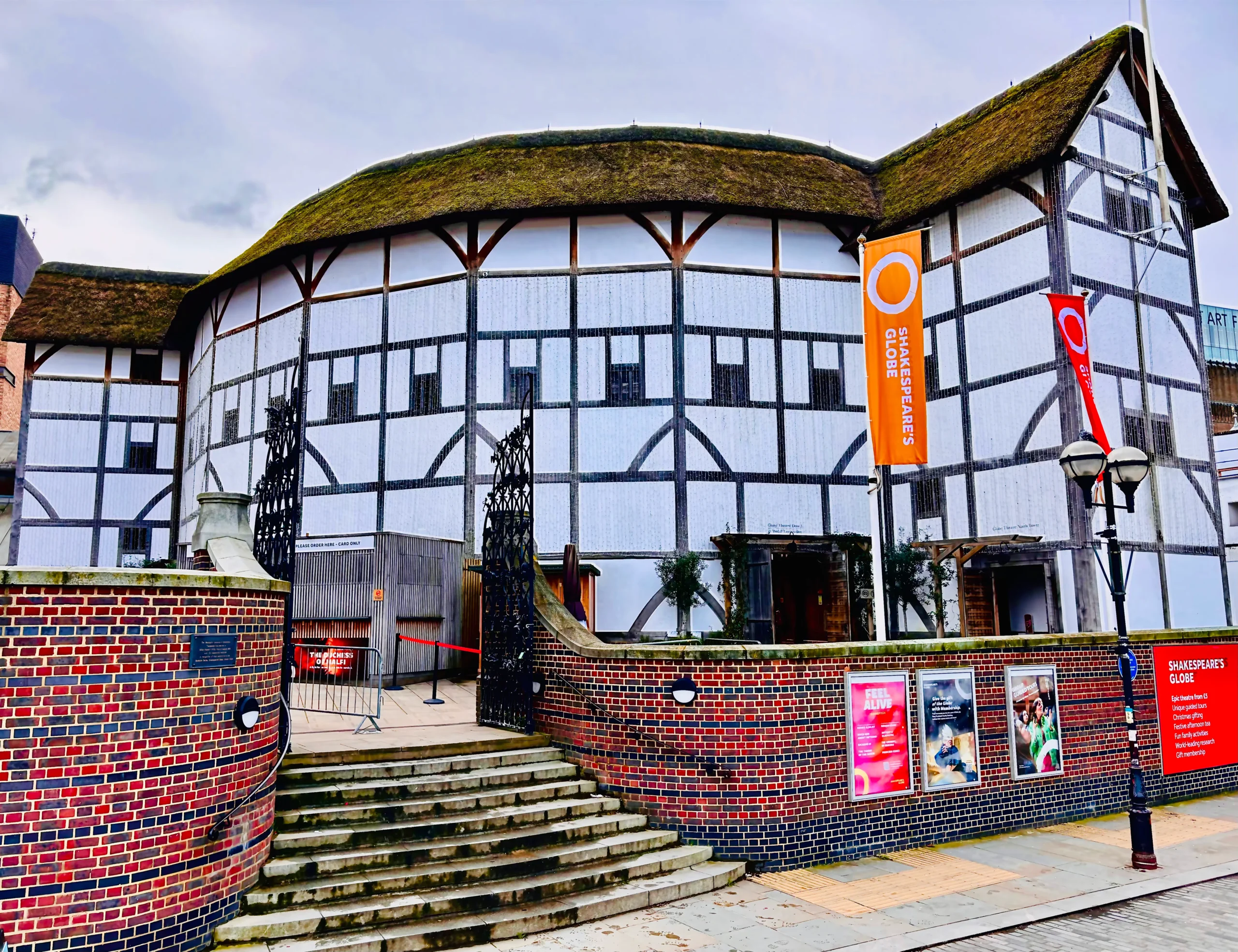
The company first performed at a playhouse in Shoreditch called The Theatre. When a dispute with the landlord turned sour, they did something extraordinary. In December 1598 they dismantled the entire building, carried the timbers across the Thames to Southwark, and used them to build a new playhouse: the Globe, which opened in 1599.
Shakespeare owned a share of the Globe itself, roughly a one-eighth stake alongside the Burbage brothers and a handful of other actors. When James I came to the throne in 1603, the company became the King’s Men under royal patronage. Most of the great plays, including Hamlet, Othello, King Lear, and Macbeth, were written for these companies and first staged at the Globe.
Shakespeare's plays and poems
Shakespeare wrote around 37 plays, though the exact count shifts depending on how you handle the ones he co-wrote. They are usually sorted into three groups: comedies, histories, and tragedies. The grouping itself comes from the way his plays were first collected after his death.
His range is the thing that still startles people. He wrote brutal tragedies like Macbeth and King Lear, sharp comedies like Twelfth Night and Much Ado About Nothing, sweeping English histories like the Henry V plays, and strange late works like The Tempest that fit no neat category.
Alongside the plays he wrote 154 sonnets and two long narrative poems, Venus and Adonis and The Rape of Lucrece. The poems were published in his lifetime and were genuinely popular. The sonnets, with their puzzles about a “fair youth” and a “dark lady,” have been argued over ever since.
Retirement, death, and the will
By around 1610 Shakespeare seems to have eased back from London life, spending more time in Stratford at New Place, the large house he had bought there. He kept a hand in, co-writing a few last plays with the younger playwright John Fletcher, but the prolific years were behind him.
He died on 23 April 1616, at the age of 52. As with his birth, the exact date is an assumption: what the record actually shows is his burial at Holy Trinity Church two days later. The cause of death is unknown. A Stratford vicar, writing some fifty years afterward, claimed Shakespeare caught a fever after a heavy night of drinking with Ben Jonson and another writer, but this is late, second-hand gossip rather than fact.
His will survives, and it is revealing in its ordinariness. It carefully divides his property, leaves small sums to friends and fellow actors to buy memorial rings, and famously leaves his wife the “second-best bed.” It says nothing about his plays. That was normal: the playscripts belonged to his company, not to him.
The First Folio: the book that saved him
Shakespeare might easily have faded. About half his plays had never been printed, and the playscripts could have been lost like so many others from the period. What saved them was a book.
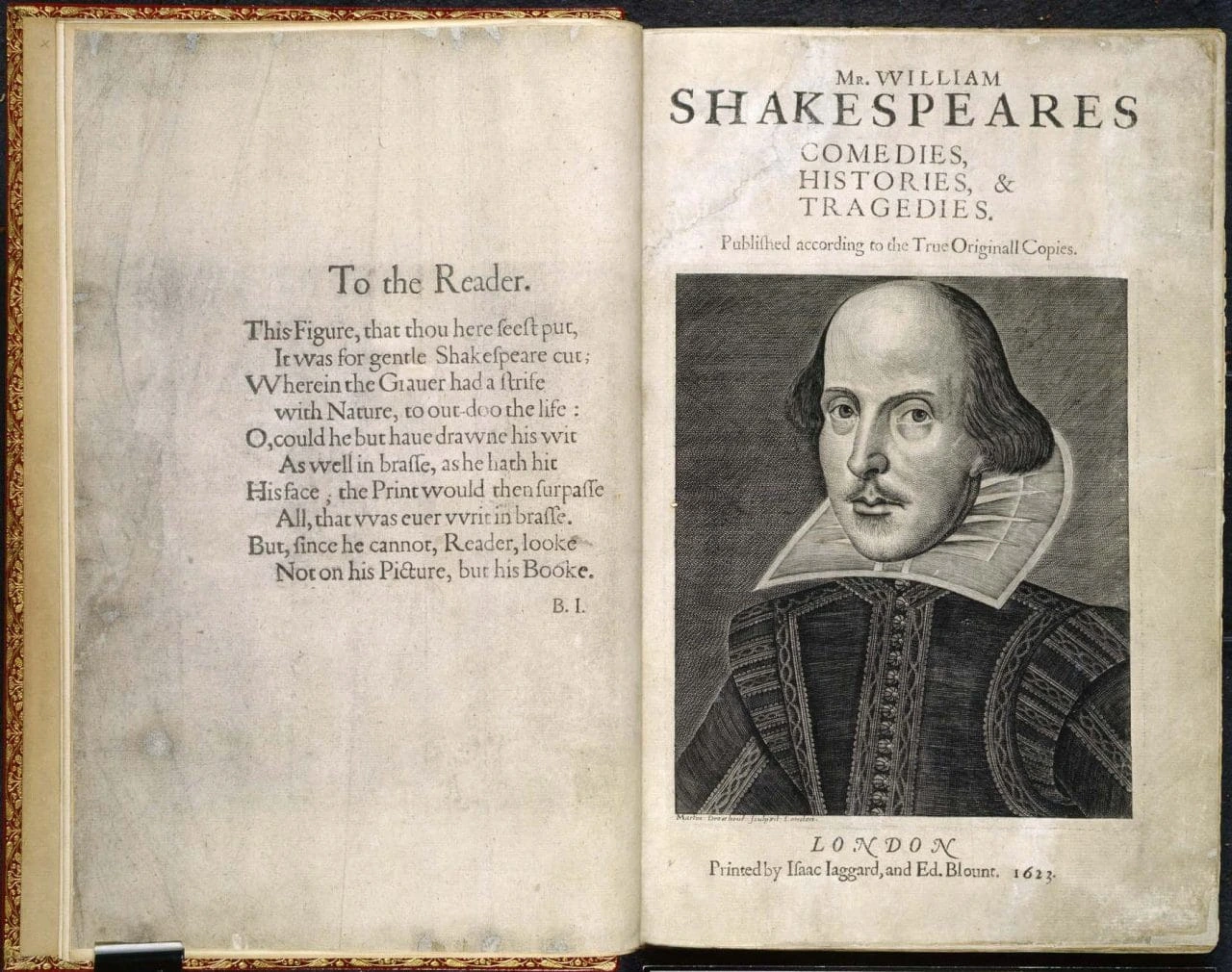
In 1623, seven years after his death, two of his former colleagues from the King’s Men, John Heminges and Henry Condell, gathered his plays into a single large volume. Its full title is Mr. William Shakespeare’s Comedies, Histories, & Tragedies, but everyone now calls it the First Folio.
It collected 36 plays, and 18 of them had never been printed before. Without it, plays including Macbeth, Twelfth Night, The Tempest, Julius Caesar, and Antony and Cleopatra might not have survived at all. Heminges and Condell were not scholars; they were actors who had worked alongside Shakespeare for years, and they put the book together as a memorial to a friend. It is one of the most important books in the English language.
Did Shakespeare really write the plays?
Every so often someone argues that the man from Stratford could not have written the plays, and that the real author was someone grander: the Earl of Oxford, Francis Bacon, or Christopher Marlowe. This is the “authorship question,” and it has a long history.
The case usually rests on snobbery dressed up as doubt. How could a glover’s son from a market town, without a university degree, have known so much about kings, law, and foreign cities? The argument tends to assume that genius requires a posh education.
Mainstream scholarship is close to unanimous that Shakespeare of Stratford wrote the works attributed to him. The documentary trail, his name on the plays, his fellow actors crediting him in the First Folio, the records of his career, all point one way. The doubt is interesting as a cultural phenomenon, but it is not a serious historical controversy.
Why Shakespeare still matters
Shakespeare shaped the English language more than any other writer. Hundreds of everyday phrases first appear in his work, from “wild-goose chase” to “in a pickle” to “break the ice.” He did not invent all of them single-handedly, but he popularised them so widely that they became permanent.
His real achievement is harder to measure. He wrote characters who feel like complete people, contradictory, self-deceiving, surprising, in a way that drama had rarely managed before. Hamlet’s hesitation, Lear’s pride, Macbeth’s ambition: these still read as recognisably human four centuries on.
That is why his plays are performed somewhere in the world almost every day, translated into more languages than any secular author, and still taught in nearly every English-speaking school. He was, as his friend and rival Ben Jonson put it, “not of an age, but for all time.”
William Shakespeare: key facts
| Baptised | 26 April 1564, Stratford-upon-Avon (birth date unknown; traditionally 23 April) |
| Died | 23 April 1616, Stratford-upon-Avon, aged 52 |
| Parents | John Shakespeare (glover) and Mary Arden |
| Spouse | Anne Hathaway (married November 1582) |
| Children | Susanna; twins Hamnet and Judith |
| Occupation | Playwright, poet, actor, theatre shareholder |
| Company | Lord Chamberlain’s Men, later the King’s Men |
| Plays | Around 37 |
| Sonnets | 154 |
| Best known for | Hamlet, Macbeth, King Lear, Romeo and Juliet, Othello |
For a list of surprising specifics, from his six surviving signatures to the plays that nearly disappeared, see 15 facts about Shakespeare you probably didn’t know.
Common questions about Shakespeare’s life
When was William Shakespeare born?
He was baptised at Holy Trinity Church in Stratford-upon-Avon on 26 April 1564. His exact birth date was not recorded; it is traditionally given as 23 April.
When did Shakespeare die?
Shakespeare died on 23 April 1616 in Stratford-upon-Avon, aged 52. He was buried at Holy Trinity Church two days later.
Who did Shakespeare marry?
He married Anne Hathaway in November 1582, when he was 18 and she was 26. They had three children: Susanna, born in 1583, and the twins Hamnet and Judith, born in 1585.
How many plays did Shakespeare write?
Around 37 plays, plus 154 sonnets and two narrative poems. The exact play count shifts depending on how the co-written plays are treated.
What is Shakespeare best known for?
He is best known for his plays, including Hamlet, Macbeth, King Lear, Romeo and Juliet and Othello, and for his 154 sonnets.
Test what you’ve learned
Read this far? See how much has stuck. The quiz runs through the dates, names and places on this page, from his Stratford baptism to the First Folio. Pick easy, medium or hard, and choose how many questions you want.
Sources
The facts on this page have been checked against:
Test Your Knowledge
Think you know your Shakespeare? Put it to the test with one of our free quizzes.
See all quizzes →